By Mark Pazniokas on Apr 20, 2021 02:36 pm
  MARK PAZNIOKAS :: CTMIRROR.ORG With the refurbished State Office B building as a backdrop, Gov. Ned Lamont celebrated advances in personnel practices. Gov. Ned Lamont and his chief operating officer, Josh Geballe, took a break Tuesday from the daily slog of managing the COVID-19 pandemic to engage their inner nerds and celebrate delivering on a campaign promise you may have forgotten. That would be the promise to modernize state government, one that generated no headlines or controversy in a 2018 campaign that offered Connecticut gubernatorial voters three flavors of business executive: Democrat, Republican and unaffiliated. Outside the refurbished State Office Building, Lamont and Geballe talked about progress in the battle to modernize Connecticut's ossified and redundant personnel system, one of the below-the-radar projects Lamont assigned to Geballe, a former IBM executive. By centralizing human resources functions that used to operate independently in nearly every state agency, Lamont said, the state has consolidated 140 personnel positions into 70. "I think we are leading by example here a little bit. You know, early on, I thought our towns could do a lot if they wanted to share a lot of back-office services, like we’re doing with technology, like we’re doing with personnel, like we’re doing with purchasing," Lamont said. "And they worried about their feisty independence." The Lamont administration has upgraded information-technology systems and overhauled purchasing procedures that seemed designed to intimidate and discourage vendors. Geballe said a new online portal at the Department of Motor Vehicles is now used by one-third of the agency customers in renewing their licenses. Geballe was hired in the first weeks of the administration as the commissioner of the Department of Administrative Services, the agency that acts as the landlord, purchasing agent, information-technology provider, construction manager and personnel department for all of state government. A year later, Lamont broadened Geballe's role by giving him the additional title of chief operating officer, bringing the back-water tasks of DAS into the governor's suite, a move branding modernization as a priority of the Democratic governor, who has an MBA from the Yale School of Management. "He wants this to be part of the legacy he leaves the state of Connecticut, that we are running this state in a more modern, more efficient way," Geballe said. "We’re providing better services to people. It’s not always the most glamorous work, but it’s something that he put the stake in the ground very early on." Government efficiency has taken on a higher profile in anticipation of a wave of retirements. A report released last month by the administration says 8,000 of the 30,000 executive-branch employees are eligible to retire by July 1, 2022, when retirement benefits will be reduced under the terms of a 2017 concession deal. A survey found about 70% of the eligible workers were leaning toward retiring. The Boston Consulting Group report identified as much as $900 million in potential savings in executive agencies with total budgets of $14 billion, while acknowledging the significant obstacles to making changes in one of the most heavily unionized public-sector workforces in the United States. “We got a pretty good study going forward,” Lamont said. “It confronts reality. We take the very best ideas, see how we can implement them. I know people belittle these studies, but what they do is they give you some of the best practices from around the rest of the country.”
Read in browser »

By Keith Phaneuf on Apr 20, 2021 05:00 am
 MARK PAZNIOKAS :: CTMIRROR.ORG Rep. Sean Scanlon addressing a chamber largely empty due to the pandemic in February. Gov. Ned Lamont kicked off this year's state budget debate by urging lawmakers to avoid broad-based tax hikes as Connecticut's economy crawls out of the coronavirus pandemic. At the same time, though, many of Lamont's fellow Democrats noted that COVID-19 has battered households as well, and — given the state's long-term fiscal challenges — it might not be possible to provide relief for some without taxing others more. But as the legislature's tax-writing panel wraps its work this week, a wide range of proposals still hang in the balance. The Finance, Revenue and Bonding Committee must by Thursday decide the fate of proposed tax hikes on digital media ads and health insurance carriers, along with a statewide property tax aimed at high-value homes. Mixed in with that are several income tax-related bills that provide relief for the poor or increase burdens on the wealthy. "We've just experienced a difficult and historic year, and it was sort of our challenge in the finance committee to meet the moment," said Rep. Sean Scanlon, D-Guilford. And while the House chair of the panel declined to speculate — with a few exceptions — on which measures would survive, he predicted the final product would both "address inequalities" and "recognize it's a fragile economy." Despite the havoc COVID-19 has wreaked on business and household budgets, state government, relatively speaking, has fared far better, thanks partly to a robust stock market that has fueled state income- and business-tax receipts. Lamont's budget office warned back in February that state finances, unless adjusted, were on pace to run $2.6 billion in the red over the next two fiscal years combined, which could largely exhaust its $3 billion rainy day fund. But since then, state officials learned Connecticut is getting $2.6 billion in federal stimulus to help with the next two-year budget, and analysts project the state budget will close on June 30 with an extra $800 million left over. In other words, the projected deficit — while significant — looks eminently manageable. Two bills Scanlon expects the committee to adopt would deliver hundreds of millions of dollars in state income tax relief to low- and middle-income households. One involves creating a new child tax credit. The second would expand the state Earned Income Tax Credit. Aimed at the working poor, the state EITC is currently set at 23% of the federal income tax credit of the same name and delivers $101 million annually to Connecticut’s poorest workers. Scanlon didn't say how much it might be increased, but one proposal before the panel would boost it by more than one-third, to 30% of the federal credit. Fonfara launches tax fairness debate But the finance committee's other chairman, Sen. John Fonfara, D-Hartford, wants to take the tax fairness debate much farther. Fonfara introduced several proposals in one omnibus measure last week, including an income tax surcharge on the capital gains earning of Connecticut's richest households — singles earning more than $500,000 per year and couples topping $1 million. He also proposed a new "consumption" tax that — despite its name — is tied directly to income, and not to purchases. The basic concept is that households with higher earnings can purchase more and therefore should pay a higher sales tax. But while Connecticut does apply special luxury sales tax rates in a few areas, such as expensive jewelry and cars, the state charges the same 6.35% to rich, poor and middle-income alike on the overwhelming bulk of goods and services. Fonfara told the CT Mirror last week that the state sales tax and the municipal property tax are the linchpins in a combined revenue system that asks too much from those least able to pay. Legislators must begin to chip away, he added, at "this gross inequity, this incredibly regressive burden [placed] on the least able in our communities." Fonfara's proposal, which is one of several bills going before the finance committee at a 9 a.m. live-streamed hearing on Tuesday, would establish six tax rates, ranging from 0.1% to 1.5%, to be applied to individuals making at least $140,000 per year. For example, a person earning $150,000 annually would be taxed at 0.1%, and pay $150. Someone earning more than $13 million annually would face the top rate and owe $195,000. Nonpartisan analysts hadn't completed their review of Fonfara's proposals late Monday, but a similar capital gains surcharge proposed two years ago was estimated to generate more than $200 million in annual revenue. Both proposals are likely to draw opposition from Lamont, who consistently has opposed increasing state taxes on the wealthy to finance relief for the poor and middle class, arguing this would drive Connecticut's biggest taxpayers to leave the state. "I've always said, we don't need more taxes, we need more taxpayers," Lamont said in his budget address back in February. The Republican minorities in both the Senate and House likely also would oppose these and other tax hikes. And Sen. Henri Martin of Bristol, ranking GOP senator on the finance committee, noted the list of proposed tax increases doesn't stop at capital gains and the consumption levy. Retailers push back against digital media ads tax Many House and Senate Democrats have voiced support for a proposed tax on digital ads, generating hundreds of millions of dollars annually from online giants such as Google and Facebook. Also still in play before the committee is a proposal from Senate President Pro Tem Martin M. Looney, D-New Haven, for a statewide tax of 1 mill aimed at homes with market values of more than $430,000. Looney has said the tax hike could finance a Democratic legislative pledge to bolster non-education grants to cities and towns by $135 million per year. But Martin said it's not that simple. "I don't believe that they [Democrats] are being sensitive at all" to the economic damage caused by COVID-19, Martin said. "I think the reality hasn't sunken in. … People are getting out of their house and starting to go back into the community." The Connecticut Retail Merchants Association teed off Monday on the digital media ads tax, predicting it would stymie any effort to get the state's economy moving. Tim Phelan, president of the association, said that while is well-intended, "the timing on this couldn't be any worse." Stephanie Do with the Council on State Taxation said Connecticut would become a national outlier. Only one state, Maryland, has a similar tax, and that measure, enacted this year, is being challenged in state and federal courts, said Do, senior tax counsel with the Washington, D.C.-based taxpayer advocacy and policy group. "It sends a very strong signal, or a very negative signal," added Phelan, who predicted advertisers would pass the costs on to already struggling businesses, some of whom would channel those expenses onto consumers. Besides Tuesday's hearing, the finance committee also has scheduled meetings for Wednesday and Thursday to finish action on proposed bills.
Read in browser »
By Jenna Carlesso on Apr 20, 2021 03:00 am
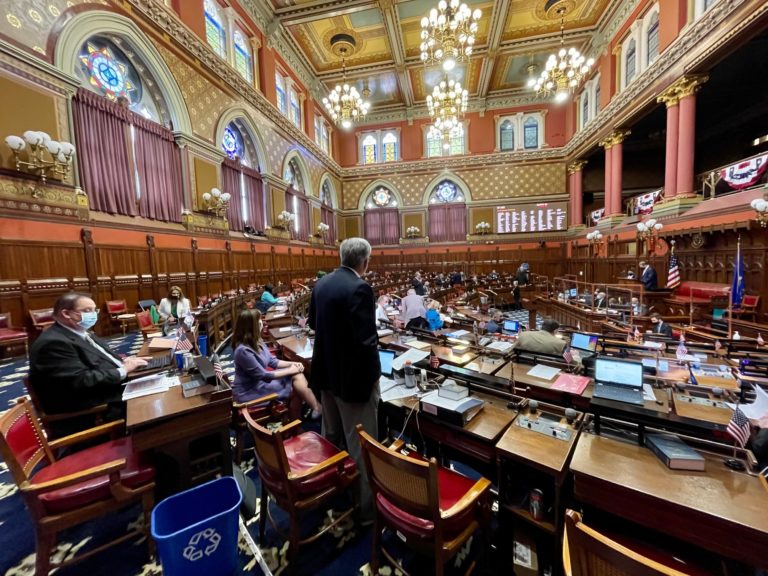 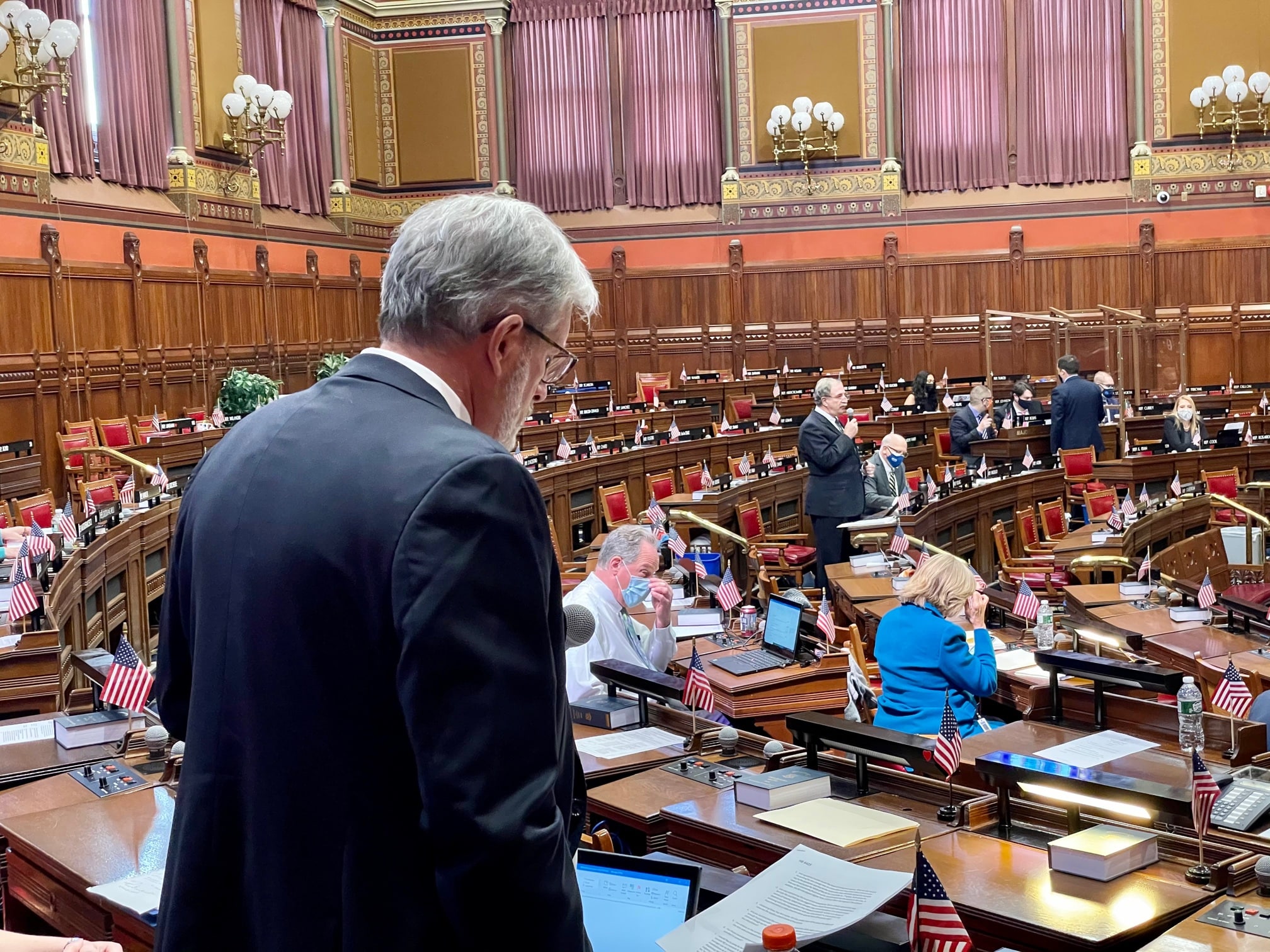 MARK PAZNIOKAS :: CTMIRROR.ORG Rep. William Petit, left, and Rep. Jonathan Steinberg debate a bill curtailing religious exemptions for school-age vaccinations. The state House of Representatives approved a bill early Tuesday that would remove Connecticut's religious exemption from mandatory school vaccinations, a major step for a hot-button proposal that has been raised three years in a row with no vote in either chamber until this week. "Because we're in the middle of a health crisis, we need to take a firm stand on the efficacy of vaccinations," said Rep. Henry Genga, an East Hartford Democrat. "We need to keep our most vulnerable residents in our decision making, always. This policy will help prevent the spread of illness and disease to those who are most vulnerable – those who have diabetes, autoimmune diseases, who make up many of our neighbors. While they cannot be vaccinated, we must do what we have to do to protect them." The bill passed by a vote of 90 to 53 after 16 hours of debate. Seven legislators were absent. The proposal drew overwhelming support from Democratic lawmakers, with a handful of Republicans crossing the aisle to join them in advancing the measure. Gov. Ned Lamont has said that if the bill were to clear both chambers, he would sign it. 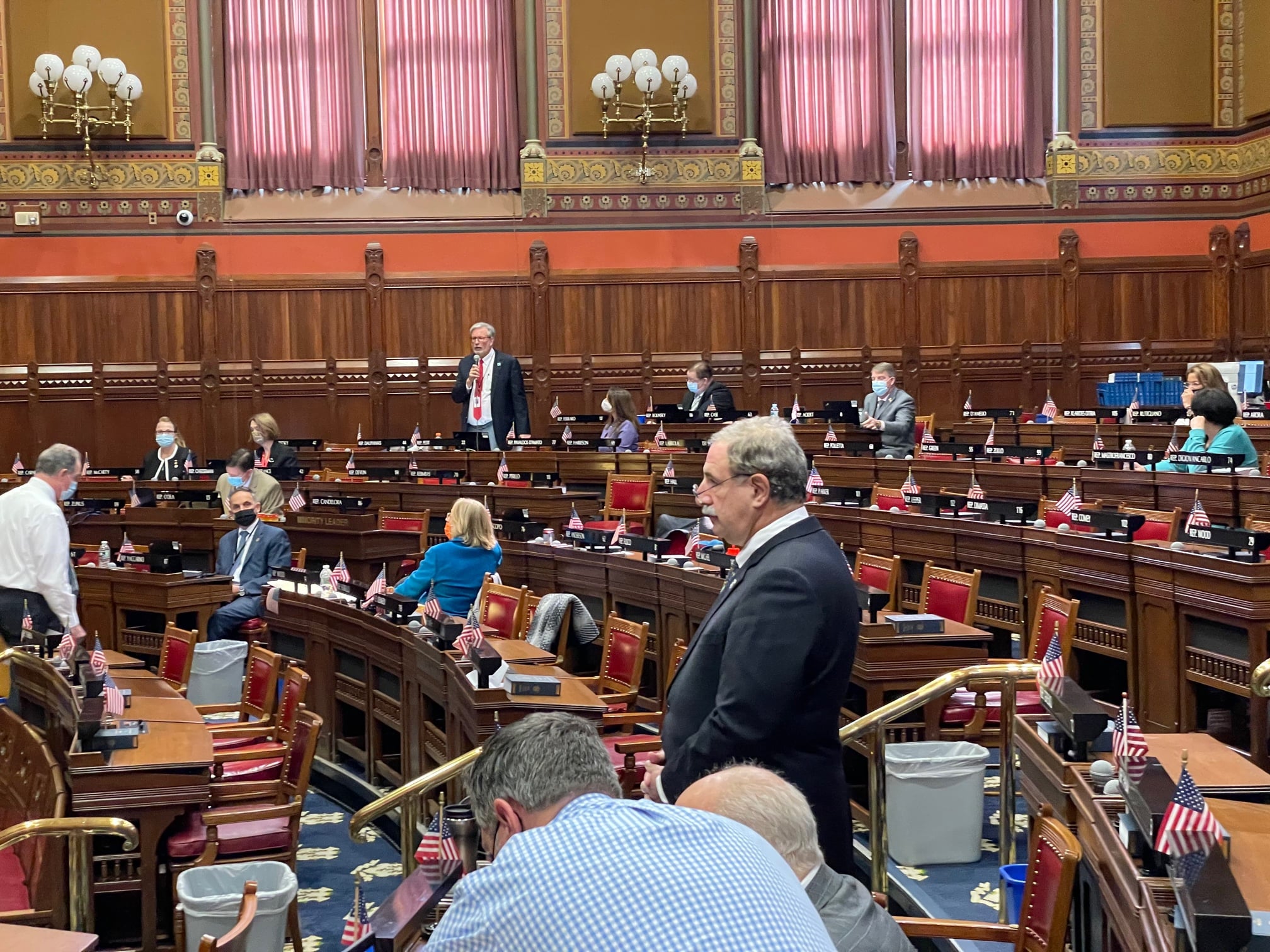 MARK PAZNIOKAS Rep. Jonathan Steinberg fields questions about the religious exemption bill. The proposal would erase the state's religious exemption beginning on Sept. 1, 2022. Children in pre-kindergarten, day care or those new to the school system would no longer be able to claim the exemption starting that day. Children who are in kindergarten through 12thgrade would still qualify for the remainder of their academic careers. An amendment allowing K-12 students to continue claiming the religious exemption passed earlier in the day Monday. Under a previous version of the bill, only those in seventh grade and up would have been permitted to keep claiming the exemption. Authors of the original proposal drew the line at seventh grade because of state data showing a larger number of children in younger grades opting for the religious exemption. But legislators said Monday that the protection should extend to students in kindergarten and older. Families who enrolled their children in school under the current rules should be able to stick with the original policy, they argued. "We know that there is a trend. And the reason why there is a grandfathering amendment is we recognize the trend will take some time to truly become dangerously impactful," said Rep. Michelle Cook, D-Torrington, a proponent of bill. "It is not necessarily with the group of children that are enrolled in school now, but with those who are younger, that [religious exemptions] continue to rise. And so what we are doing is putting a pause – or, as some of my colleagues like to say, shutting off the spigot – and saying that from here on out, your children should be vaccinated" or be homeschooled. Along with removing the religious exemption, the bill requires the state's public health commissioner to annually release school-by-school immunization data; helps parents who cannot afford vaccines for their children by mandating that cities and towns cover the expense; and creates a board that will review Connecticut's vaccine program and issue recommendations. Several Republican lawmakers criticized the measure on Monday, questioning why younger children were deemed a "threat" while older students could continue claiming the exemption. Some argued the change should also include those in day care and pre-kindergarten, saying the bill would divide families. Rep. Gale Mastrofrancesco, R-Wolcott, expressed concern for the parents of children in day care and pre-kindergarten, along with those whose kids will enroll in school in the future. Data from the state Department of Public Health show that in the 2019-20 school year, the most recent available, 683 children enrolled in pre-kindergarten claimed the religious exemption. 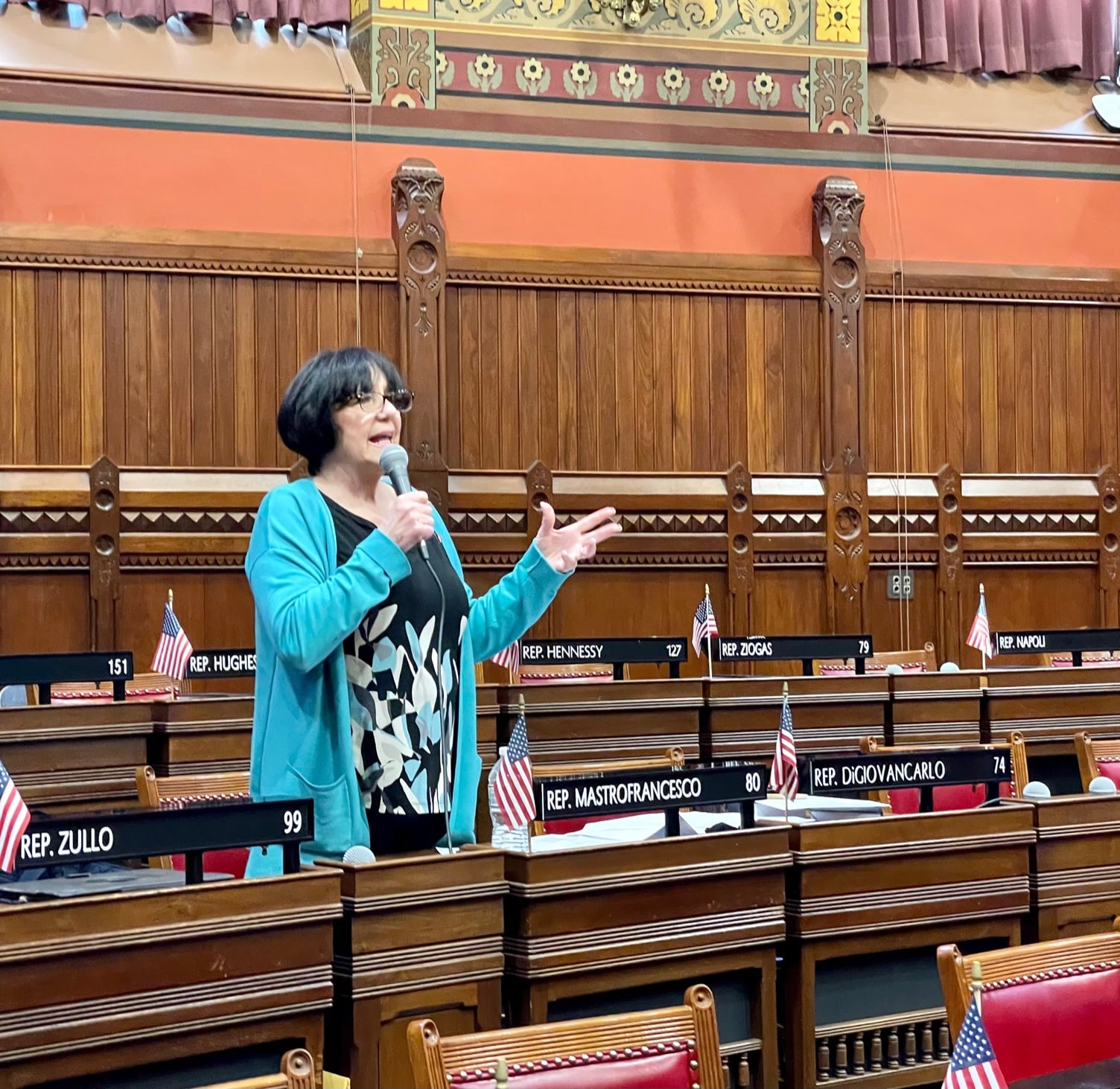 MARK PAZNIOKAS Rep. Gale Mastrofrancesco criticizes an amendment to the religious exemption bill during the House session Monday. "What are these parents supposed to do?" Mastrofrancesco said. "Are they supposed to quit their jobs? Because their children will be segregated from the community." "I call this whole bill segregation," she added. "It's discrimination. We are picking winners and losers." Rep. Anne Dauphinais, R-Killingly, called the measure "arguably the worst bill we've seen in the history of Connecticut." "This concept of grandfathering doesn't make a bad bill better," she said. "We're trying to salvage whatever we can from a crappy, horrible bill. … We're attacking the religious beliefs of individuals in this state." Proponents of the measure have cited concern for immunocompromised students who cannot be vaccinated for medical reasons. But Dauphinais questioned Monday whether those children should be attending school. "The immunocompromised who are very, very fragile, who would be at a threat to get anything – I would argue shouldn't even be in school," she said. "We're talking about children with leukemia, perhaps children on chemo, children who could be deathly affected by someone who had a cold or strep [throat] or any other things that go throughout the schools." Republicans entered 50 amendments to the bill Monday, proposing everything from a requirement that the General Assembly approve any new vaccines added to the state’s mandatory immunization list to a directive that the health department produce a report detailing the bill's impact on minority children and those who qualify for free school lunches. Seven amendments were raised and only two were successful – the bipartisan change allowing K-12 students to continue using the exemption, and a Republican proposal permitting K-12 children who transfer schools to keep claiming the religious exemption.  MARK PAZNIOKAS :: CTMIRROR.ORG Steinberg testifies in favor of the bill. Rep. Jonathan Steinberg, a Westport Democrat who is a co-chair of the Public Health Committee, pointed to the rising number of students claiming the exemption each year as a reason he supported the bill. In the 2019-20 school year, the most recent data available, 8,328 children – from pre-kindergarten through 12thgrade – in Connecticut elected the religious exemption. That's up from 7,782 in 2018-19 and 7,042 in 2017-18. "The trend line for vaccinations is incontrovertible," Steinberg said. "It's clear that the situation is not getting better, it's getting worse." Rep. Mary Mushinsky, D-Wallingford, said the state should be watching out for all children, especially those who have compromised immune systems. "We live in a community, not an island, and that's why this bill is important," she said. "A particular group we're interested in is those who cannot be vaccinated because of some serious medical reason; for example, they're a cancer survivor, they have an immune disorder, they have a genetic disease. There's a small number in each classroom that cannot be vaccinated and for their sake we need to vaccinate everyone else in their community." If the bill clears the Senate and is signed into law, Connecticut would become the sixth state without a religious exemption. New York, Maine, Mississippi, West Virginia and California do not have the vaccine exemption; 45 states and Washington D.C. do, according to the National Conference of State Legislatures. The measure would not force children to be immunized; children in day care and pre-kindergarten, along with those entering the school system in the future, would be home schooled if their parents choose not to vaccinate them for religious reasons.  Mark Pazniokas :: CT Mirror Protesters gathered outside the state Capitol Monday evening as the House debated the religious exemption bill. Lamont reiterated his support during a news conference Monday. "I would sign it," he said of the measure. "We have learned, over and over again, over the last six months that vaccinations work; vaccinations keep me safe, keep us safe, keep my classroom safe … I'm ready to support that bill." Leaders in the Senate have said they plan to vote on the bill by the end of April. Senate President Pro Tem Martin Looney told The CT Mirror in March that a majority of legislators in his chamber were in favor of the proposal. "I believe we have the votes in the Senate to pass a strong bill," he said. "I think people, over the years prior to the pandemic, had become a little too casual about some very serious diseases because they no longer saw them having an impact. We're now seeing the impact of a disease that went close to a year without having an effective vaccine. That should create a climate of greater support for broad-based vaccinations." CT Mirror Reporter Jacqueline Rabe Thomas contributed to this story.
Read in browser »
Recent Articles:
| 


No comments:
Post a Comment