Nicholas Say posted: "In 2019, Fleek was founded under the name of Terminal, a development platform for Ethereum. A year later, it was rebranded to Fleek and transitioned to becoming a Web3 infrastructure platform that offers IPFS storage infrastructure and hosting of static w" Blockonomi
In 2019, Fleek was founded under the name of Terminal, a development platform for Ethereum. A year later, it was rebranded to Fleek and transitioned to becoming a Web3 infrastructure platform that offers IPFS storage infrastructure and hosting of static websites.
The platform aims to give developers an easy-to-use and abstracted experience when building Web3 apps, abstracting the use of Web3 infrastructure to have seamless deployments and storage, similar to the experience you'd see in Web2 today.
Fleek's Products
Fleek.xyz - The 'Airbnb' of Decentralized Web Infrastructure
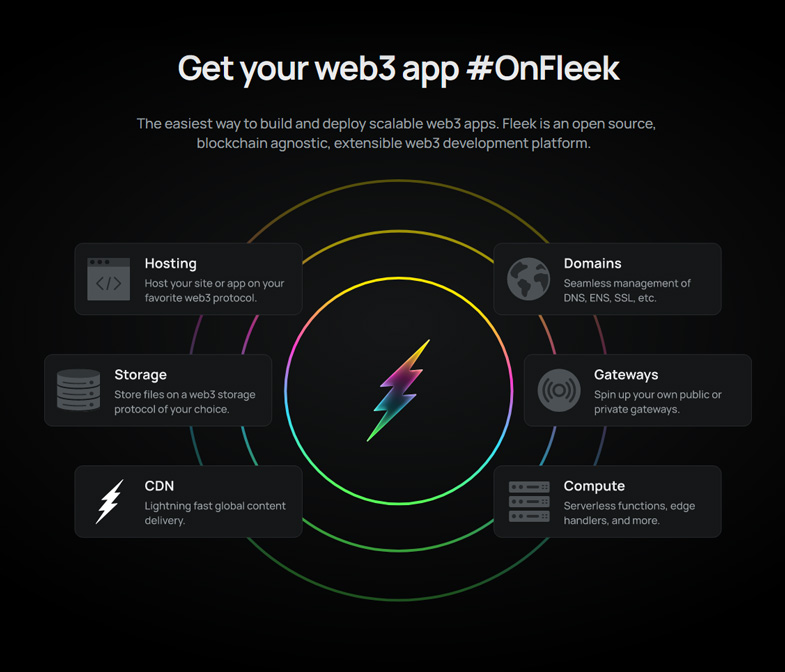
The new style platform is developed as a fully modular, protocol and chain agnostic suite of Web3 infrastructure services, providing an ever-expanding set of infrastructure services such as storage, computation, hosting, or domains.
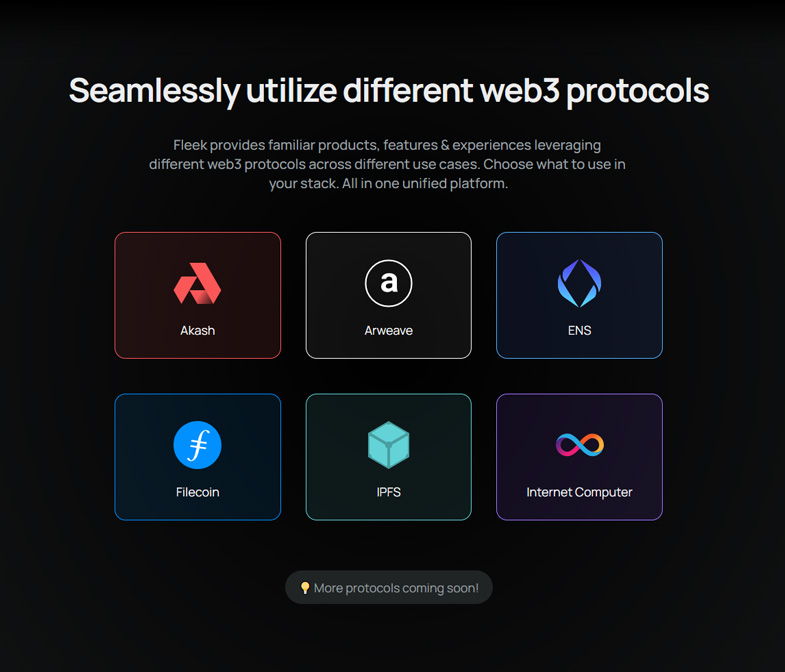
Not only that, but it also provides services that can easily expand to any provider/protocol like Arweave, filecoin, IPFS on storage, and ENS, HNS, DNS on domains, or computation via Akash/FVM in the future.
Fleek is an open source, blockchain agnostic, extensible web3 development platform.
Since then, the platform allows providers to be able to build their integrations once open source. With a fully abstracted and broad folder of infra services offered, the developer can pick and choose as they wish.
Fleek Network - The Decentralized Edge Network
Web2 allows you to cover all your infrastructure needs from single sources, in a unified developer environment and experience.
Meanwhile, this is impossible in Web3 as all providers and pieces of the puzzle are spread out, have their own integration and use experiences, are disconnected from each other, and do not always have their use-case laid out for the user.
IPFS itself is not specifically built to host websites, which is an example. So, Fleek's role is to abstract and surface use cases on top of those technologies like video streaming modules on Livepeer, SSR on Akash, or Fleek Network.
Fleek Network is the company's 2nd project, a decentralized content and application delivery network, delivering edge services like computation, SSR, and dn-oriented services like cache/acceleration.
What Is Fleek Doing to Help Web3?
Currently, most popular Web3 apps and use cases use Cloudflare for accelerating their app and content as users are not tolerating slow loading apps/content.
Because Web3 protocols don't incentivize performant delivery of content directly from their networks, users are forced to stick to a performant cache layer such as Cloudflare in between all these protocols and their apps.
Fleek Network is built for anyone who wants both fast and trustless content acceleration.
Also, the usage of the network will be fully transparent and publicly available for the world to leverage. Therefore, all content will be IPLD-based and content addressable, creating a public record, much like how smart contracts bring radical transparency to financial transactions.
The user would have access to an SDK and browser app experience to leverage Fleek Network's cache and computation.
The user submits files or data to be cached by the network, and the network outputs an endpoint/URL that the user will consume somewhere in an application or project.
In the terms of computation, the user would be able to leverage Fleek Network to execute compute tasks and operations (e.g. Server Side Rendering, data processing), and the network would utilize the decentralized edge network of nodes to performantly execute the code/instruction and return the user their needed output.
Fleek Network will play a very important role in the decentralization of the CDN and edge layer, ending the Cloudflare and AWS dependence on Web3.
NFAs
Well, you've heard of NFTs, so what about NFAs?
NFAs are implemented based on the ERC721 NFT standard holding the on-chain metadata for everything about your app, including name, domain, build history, infra endpoints, and many more.
However, unlike most NFTs, NFA's will probably update frequently. This is a new standard for placing apps and infrastructure on-chain.
Today, Web3 apps are still using centralized solutions. This not only leaves Web3 frontends vulnerable to censorship and hacks but also creates financial and even criminal liability for Web3 projects and their founders.
In this case, NFAs allow smart contracts to own and control all of the infrastructure and assets that encompass your Web3 app.
You can mint your app as an NFA, meaning transferring the app. As so, anything you'd usually do/own/pay for as a founder can now be automated to the NFA. In other words, you can do with NFAs the same as people are doing with NFTs.
The combination of Fleek Network and NFA is to remove the control over infrastructure to the NFA itself and out of the company/team's hand as well as allow the decentralized hosting and creation of access points.
Therefore, users have decentralizing control and can sell or transfer their projects with full control of the infra. In addition, users can mint a copy of the NFA and point to their hosting/infrastructure to create an access point to that application's backend.
What Fleek Offers
On Fleek.xyz
Three interfaces that a developer can interact with its folder of infrastructure and deployment services, including the UI (application), the CLI (the command-line interface), and the SDK (library used to integrate Fleek's services into other environments, e.g. storage in a frontend Web3 app).
Instead of using Lambda to do the computation, you would use Fleek to execute the computation on Akash or Fleek Network.
The developer would sign up to Fleek, and get access to APIs, the SDK, and interaction points they can use to leverage these protocols. They would use the SDK to call these services where needed in their applications and get charged based on usage.
Fleek provides familiar products, features & experiences leveraging different web3 protocols across different use cases.
Instead of using Alchemy or centralized RPC providers, a developer could ask Fleek to generate and deploy a decentralized RPC endpoint via Pocket. Fleek is a distributor and orchestrator of all decentralized Web3 infrastructure.
On the other hand, a CI/CD and automatic app/site deployment flow helps developers set up a new project, and build and deploy it automatically, hosted on a Web3 protocol.
The basic flow is setting up a project > hooking the GitHub or Git repository source to Fleek > specifying how it will build and deploy (handled by Fleek or locally by the user), and selecting where it will be deployed infrastructure-wise (IPFS today is the option).
Fleek will execute all required orchestrations to have that flow happen, and output a preview URL of the project live and hosted on the chain.
The user can then set a custom DNS, ENS, or other Web3 type of domain on top of its project via Fleek.
Once set, the development and deployment flow is automatic and continuous, meaning the developer can continue to iterate, commit changes, and Fleek automatically builds, previews them to the user, and updates the production environment when told.
Fleek Network
As said, you will have access to an SDK and browser app experience to leverage Fleek Network's cache and computation.
You can submit files or data to be cached by the network, and the network outputs an endpoint/URL that the user will consume somewhere in an application or project.
Also, you can leverage Fleek Network to execute compute tasks and operations and the network will use the decentralized edge network of nodes to performantly execute the code/instruction and return your needed output.
Furthermore, node operators can join the network by running node servers, staking many tokens in the network, and providing computing, storage, cache, etc, as well as validation in the network itself.
Fleek: The Takeaway
Fleek could be better than existing tech due to the superior infrastructure, but also a sandbox experience that connects all decentralized protocols into a single experience.
Centralized CDNs and Edge providers like Cloudflare and AWS, there is no decentralized competitor on edge live today like what Fleek Network does.




No comments:
Post a Comment